Choosing iron front entry doors in 2026 involves more than selecting an impressive façade. Global buyers must examine steel thickness, welding quality, corrosion protection, thermal performance, hardware, and local installation conditions. A door may look magnificent in a showroom yet perform poorly beside coastal air, heavy rain, or extreme winter temperatures. Small details matter. Check the frame.
Samuel Yellin, the respected American master blacksmith, is often associated with the principle, “The material must speak for itself.” That idea remains valuable today. Quality iron front entry doors should reveal disciplined craftsmanship through balanced proportions, clean welds, secure hinges, and durable finishes. Decorative scrollwork should not hide weak construction. It should support the door’s character and function.
This guide examines leading 2026 options for homeowners, architects, developers, and hospitality buyers worldwide. It considers hand-forged designs, modern steel systems, thermal breaks, multipoint locks, glass selection, maintenance needs, and delivery reliability. Regional requirements still differ. A design suitable for a dry inland villa may need stronger coatings near saltwater. Even expert recommendations require review.
There is no perfect door. Budget, climate, security expectations, and architectural style create compromises. Buyers should request material specifications, finish samples, warranty terms, and installation drawings before ordering. A beautiful entrance deserves careful verification. That step is easy to overlook.
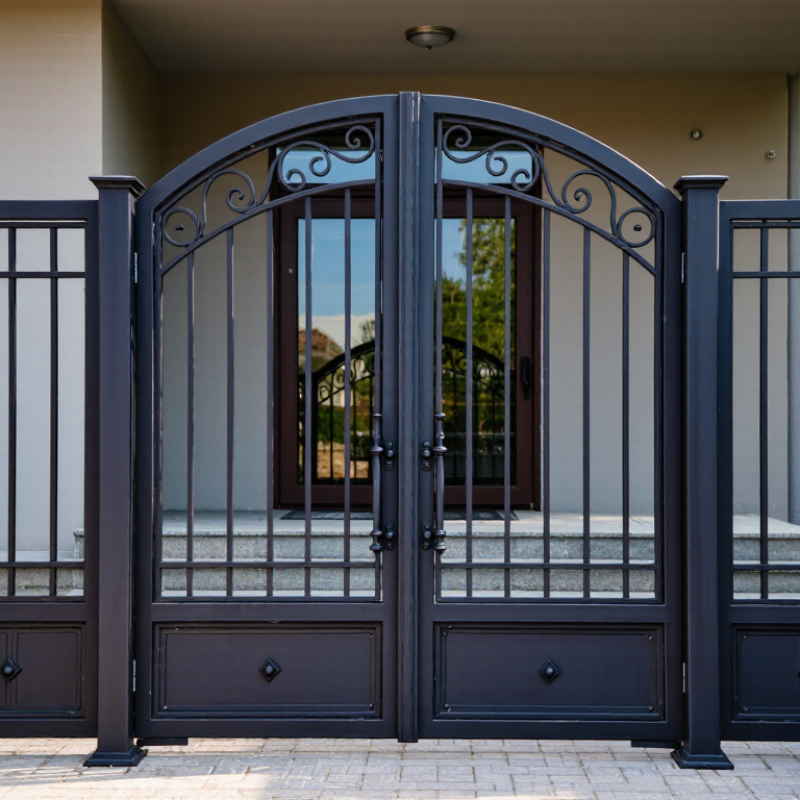
2026 Best Iron Front Entry Doors for Global Buyers
A strong iron front door starts with its steel anatomy. Grade 304 stainless steel suits most sheltered, inland entrances. It contains about 18% chromium and 8% nickel, supporting corrosion resistance and clean appearance. Grade 316 adds molybdenum, improving protection near salt spray and humid coastal air. The World Stainless Association reported approximately 58.4 million tonnes of stainless crude steel production in 2023. That scale supports supply confidence, but it does not guarantee every door uses genuine, traceable material.
Look closely at the thermal break. A continuous insulated section between inner and outer metal frames reduces heat transfer through the door assembly. The U.S. Department of Energy identifies doors and other openings as important parts of a building envelope. Yet a thermal break alone cannot fix poor installation. Gaps around the frame may create cold drafts, condensation, and street noise. Small errors matter.
Glass selection needs equal attention. Low-emissivity double glazing can reduce radiant heat loss, while laminated glass improves impact resistance and sound control. The National Fenestration Rating Council evaluates U-factor and solar heat gain coefficient, giving buyers comparable performance data. Lower U-factor generally means better insulation. Higher solar heat gain may help cold climates but increase cooling loads in hot regions. I would not choose glass by appearance alone. A beautiful panel can still become a weak thermal point. Door samples should reveal spacer quality, gasket compression, drainage paths, and actual test ratings.
For global buyers, an iron entry door should be judged by tested performance, not decorative weight. EN 1627 classifies complete door assemblies, including the frame, lock, hinges, and installation. RC2 requires three minutes of active attack time with basic tools. RC3 raises this to five minutes and permits stronger hand tools. RC4 reaches ten minutes and includes heavier tools, such as axes and power drills. These figures come from the European resistance-class testing framework, not from showroom claims.
UL 752 uses a different method. It defines ten bullet-resistance levels, with each level linked to specific ammunition, velocity, distance, and impact conditions. A certified result applies only to the tested construction. It does not automatically prove forced-entry resistance, fire protection, or secure installation. That distinction matters.
“Bulletproof” is an unreliable sales phrase.
In practice, I inspect the door leaf, glazing, frame anchoring, threshold, and lock protection together. A strong panel can still fail around a poorly fixed frame. Buyers should request the laboratory report, test level, ammunition details, and installation limits. RC4 is not always the sensible choice. It can add weight, cost, and alignment challenges. My own preference is cautious specification: match the rating to the building’s risk, location, and daily use. The neatest answer is rarely the safest one.
For an iron front door, energy performance starts with the NFRC label, not appearance. A target U-Factor of 0.27 or lower indicates strong resistance to heat transfer. Lower values generally improve comfort in cold climates. However, the entire door assembly matters, including glass, frame, weatherstripping, and threshold.
The National Fenestration Rating Council uses standardized procedures for U-Factor and SHGC testing. Its ratings help buyers compare products across markets. The U.S. Department of Energy reports that windows and doors can account for roughly 25%–30% of residential heating and cooling energy use. This makes careful selection worthwhile. SHGC measures how much solar heat enters through glazing. A lower rating can reduce overheating in hot regions, while a moderate rating may help passive heating in colder areas. Climate direction matters.
Tips: Request a complete NFRC-certified rating for the finished door assembly. Check U-Factor, SHGC, visible transmittance, and air leakage together. Ask for thermal-break details inside the iron frame. A beautiful metal frame can still create a cold edge. Installation is often the weak point. Even a U-Factor of 0.27 may perform poorly when the sill is uneven or the seals are compressed incorrectly. I would also question ratings based only on glass. That approach is incomplete, but still common in online listings.
For global buyers, the best iron front door is not merely heavy or attractive. It must match the destination market’s compliance path. CE requirements may apply to relevant external doorsets under applicable European rules and harmonized standards. UKCA follows the United Kingdom’s product framework, but acceptance routes can change. Verify the current position before ordering. Ask for a Declaration of Performance, test scope, factory traceability, and installation instructions.
ASTM E331 evaluates resistance to water penetration under controlled static pressure. It does not prove every weather condition. A credible report should identify specimen size, pressure, duration, drainage, and failure observations. Iron frames need careful attention around thresholds, seals, hinges, and wall joints. Small installation gaps can defeat a strong laboratory result. This is easy to underestimate.
AAMA 2605 addresses high-performance organic coatings, including color retention, chalking, gloss, and corrosion resistance. Confirm coating preparation, thickness, pretreatment, exposure evidence, and warranty terms. The finish may look excellent on arrival, yet coastal salt and trapped moisture remain practical risks. I would compare the tested assembly with the offered model, not just the certificate title. No checklist is perfect. Recheck local building rules, accessibility, energy performance, and fire requirements with a qualified professional before shipment.
This chart compares the primary role of each reference for iron front entry doors. A value of 2 means the reference directly addresses the category, while 0 means it is not the primary purpose of that reference. The values are a scope mapping, not a certification score.
CE and UKCA relate to applicable product conformity and market-access routes. ASTM E331 is a laboratory test method for resistance to water penetration through exterior windows, skylights, doors, and curtain walls. AAMA 2605 specifies performance requirements for high-performance organic coatings on architectural products. Actual obligations depend on the destination market, product configuration, and applicable regulatory route.
For global buyers, corrosion class matters more than a polished showroom finish. ISO 12944 classifies protective paint systems from C1 to C5, based on atmospheric exposure. C3 suits moderate urban conditions, while C4 and C5 fit coastal, industrial, or high-humidity locations. The NACE IMPACT study estimated global corrosion costs at about US$2.5 trillion annually, or 3.4% of global GDP. That figure makes coating specifications worth checking. Ask for the tested system, dry-film thickness, surface preparation, and repair method. A label alone proves little.
Warranty language needs equal attention. A ten-year coating warranty may exclude salt exposure, poor drainage, installation damage, and unapproved cleaning chemicals. Hardware coverage can be shorter. Request separate terms for steel, finish, hinges, locks, glass, and labor. Lead times often range from six to sixteen weeks, but custom grilles, oversized frames, and container scheduling can extend delivery. One missed measurement can add several weeks. I have seen attractive quotations fail at the threshold detail.
Cost comparison should include the door, frame, finish upgrades, packaging, insurance, freight, duties, local handling, and installation. Construction cost databases, including RSMeans, show that installation and regional labor can materially change total project cost. A low factory price may become expensive after inland delivery and corrosion repairs. Compare landed cost per opening, not the catalog price. This approach is less glamorous, but more reliable. Specifications still need local review.